Since 1852, we've been at the forefront of supplying air compressor for pet blowing, specifically designed to integrate seamlessly with bottle blowing machines. Our oil-free compressors are built from scratch to fulfill the demanding standards of the industry.

Our Product Range
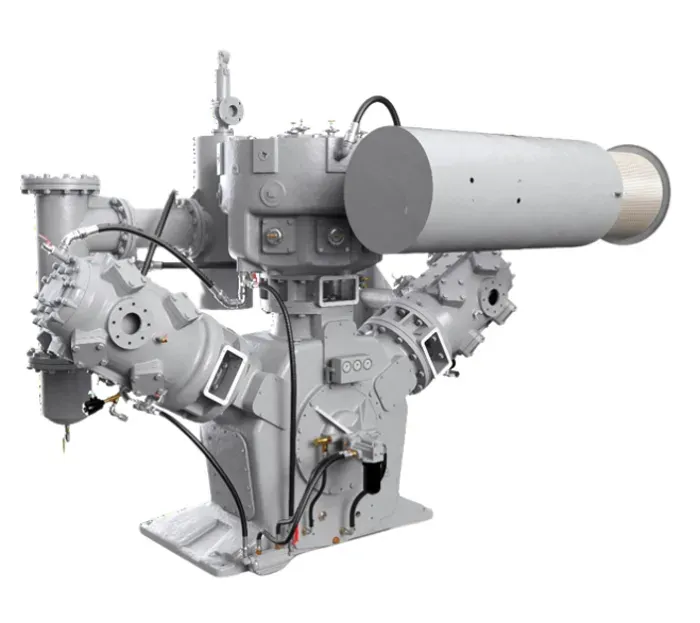
Oil-Free Reciprocating Compressor - 15 barg
Engineered for exceptional efficiency and reliability, delivering up to 15 Bar-g pressure for diverse industrial applications.
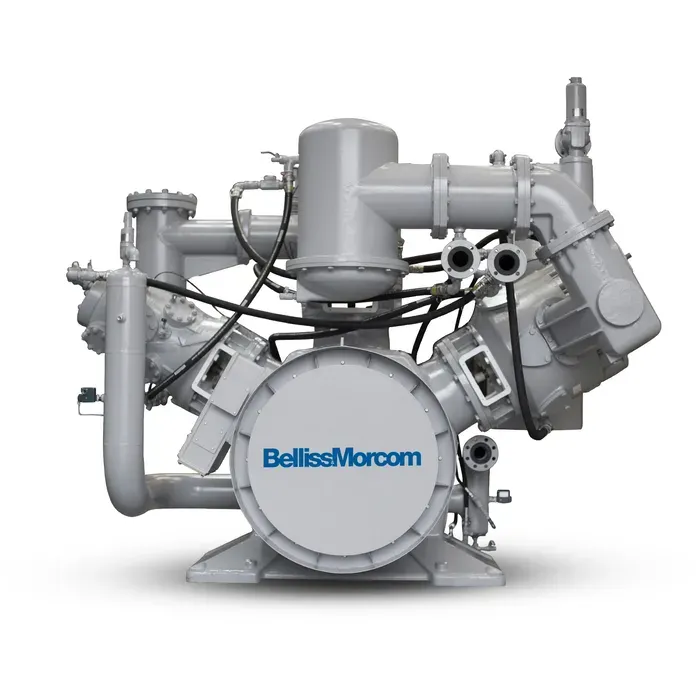
Oil Free Reciprocating Compressors-Up to 45 Bar-g
Oil-free reciprocating compressors up to 45 Bar(g) series are built with proven double-acting piston technology, delivering exceptional efficiency
Challenges Faced by PET Bottle Producers
- Environmental Issues: PET bottles can cause plastic pollution because they're often thrown away after one use. Even though PET can be recycled, not enough of it is, leading to harm to the environment. The process of making PET also adds to greenhouse gas emissions.
- Recycling and Material Quality: Recycling PET can lower the quality of the plastic. This means that recycled PET might not always be good enough for food containers without a lot of cleaning and processing. Also, having different colors and types of plastic together can make recycling harder and lower the quality of the recycled plastic.
- Energy Use: Making PET bottles, especially blow molding, uses a lot of energy. This raises the cost of making the bottles and adds to their environmental impact. Finding ways to use less energy without hurting production speed or bottle quality is a challenge.
- Material Costs Can Change: The price and availability of the materials to make PET, like purified terephthalic acid (PTA) and monoethylene glycol (MEG), can go up and down a lot. This can affect how cost-effective it is to make PET bottles and make it hard for manufacturers to plan their finances.
- Health and Safety: There's ongoing research into whether PET bottles might be harmful to health, like if they release chemicals into their contents when they get too hot. Regulatory bodies like the FDA say PET is safe, but public opinion and regulations can still affect the industry.
- Competition: PET bottles are up against other materials like glass, aluminum, and biodegradable plastics. Each of these has its own benefits and could be seen as more eco-friendly or better for certain drinks. The PET industry has to keep innovating to keep its place in the market.
- Tech Investments: New technologies and automation can improve efficiency and cut costs, but they also cost a lot to start using. Smaller manufacturers might have a hard time affording these technologies, which could put them at a disadvantage.
Key Benefits of Air Compressor for Pet Blowing
✅ High efficiency and low energy consumption ensured by shaftless motors and the ability to run at reduced loading.
✅ Minimized maintenance costs due to unique "V" and "W" design which puts less load on rings and focus on component design and material selection.
✅ Unrivalled reliability backed up by a market-leading 5 year+ warranty with a re-warrant option.
✅ Maximum uptime given the dynamically balanced design which minimises the wear and tear on components.
✅ Space-saving potential enabled by a design that is more compact than those of our competitors and allows you to save your valuable floor space.
✅ Numerous customization options with a range of additional features offering operators enhanced levels of monitoring, control and cost savings.
Reciprocating Air Compressors for PET Bottle Blowing
Belliss & Morcom offers an extensive range of cost-effective oil free high pressure reciprocating air compressors that are tailored and made for the PET Bottle blowing sector. The range offers:
- Volumetric flow from ~400 m3/hr to ~3200m3/hr with a delivery pressure range from 20 to 45 barg.
- V and W cylinder designs facilitate dynamic balancing and reduce the need for special foundations and also limit the loading and wear of piston rings/cylinder liners.
- Shaftless motors transfer 100% of the power input to the compressor crankshaft and have none of the inherent losses associated with a belt or flexible coupling drives.
Technical Specification Product Range Overview
50Hz / 40 Barg |
|
|
|
|
|---|---|---|---|---|
Model | Capacity FAD | Delivery Pressure | Speed rpm | Shaft Power |
VH7 | 420 M³ /HR | 40 Barg | 735 | 75 kW |
VH9 | 580 M³ /HR | 40 Barg | 985 | 101 kW |
VH12 | 729 M³ /HR | 40 Barg | 590 | 116 kW |
VH15 | 916 M³ /HR | 40 Barg | 735 | 146 kW |
VH18 | 1116 M³ /HR | 40 Barg | 590 | 185 kW |
VH21 | 1402 M³ /HR | 40 Barg | 735 | 227 kW |
VH25 | 1500 M³ /HR | 40 Barg | 735 | 242 kW |
WH28 | 1680 M³ /HR | 40 Barg | 735 | 258 kW |
WH29 | 1800 M³ /HR | 40 Barg | 735 | 270 kW |
WH35 | 2120 M³ /HR | 40 Barg | 735 | 330 kW |
WH40 | 2300 M³ /HR | 40 Barg | 735 | 350 kW |
WH45 | 2700 M³ /HR | 40 Barg | 735 | 437 kW |
WH50 | 3200 M³ /HR | 40 Barg | 735 | 505 kW |
Complete PET Bottle Blowing Compressor System
On top of our standard PET compressors, our portfolio of products and services for the bottle blowing machine industry also encompasses a range of additional features. They are designed to offer your factory enhanced levels of monitoring, control and cost savings, and include:
- The AirPET control system for multi-compressor networks – ensures accurate control of network pressure and effective plant management.
- Variable Speed Drives for variable capacity control, accurate and repeatable pressure control, reduced energy costs and extended component life.
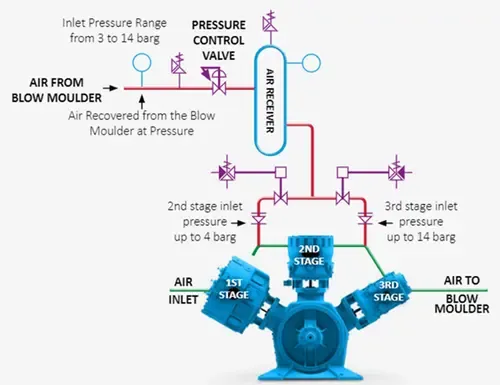
- An Air Recovery System – designed to accommodate and “recycle” pressure returned from the blow moulding machines, and reduce compressor energy consumption.
- A Heat Recovery System - The cooling system can be modified to pre-heat feed water for the heating systems.
- Custom Components – a wide selection of ancillary items such as starter control panels, filters and optional cooling systems are available to suit all site conditions.
- Energy Audits – to help you reduce compressed air energy costs and CO2 emissions at your bottle blowing plant.
What is the PET?
Polyethylene Terephthalate (PET) is the plastic used to manufacture bottles and containers for a myriad of consumer products, including carbonated soft drinks and water. PET is a thermoplastic and using it to produce bottles in the desired sizes and shapes typically involves blowing high quality air at high pressures (25 to 40 barg) into presets that shape a molding cavity.
PET remains a popular packaging material for a variety of reasons including:
- light weight, only about 20 grams for a 2 liter container
- can be molded into a variety of shapes and sizes
- gives the product contained (juices, water, carbonated beverages) ”shelf appeal”
- environmentally friendly and can be easily recycled
- does not extract nor transfer flavors to the package drink
- offers great chemical resistance
- can be easily sterilized
- shatter-proof
The PET Bottle Blowing Machine Process
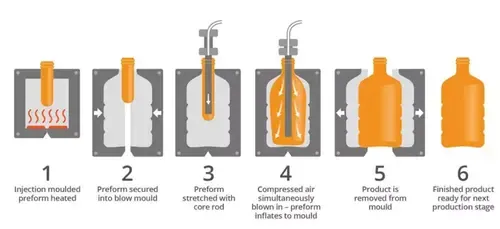
The PET Bottle blowing process begins with PET resin which is crystalline, opaque and brittle in nature and softens at ~ 245oC. The resin is dried before going into an injection moulder, forming a PET preform. The preform is then heated and clamped in a PET blow moulder tool. It is moulded into its desired shape with the use of blown high pressure air.
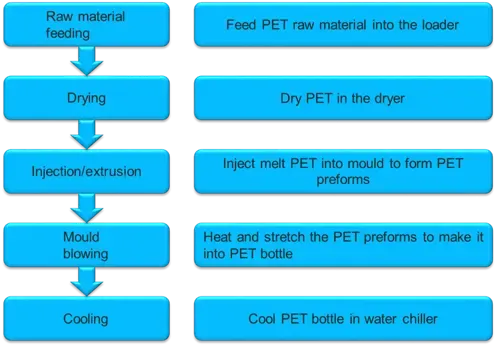
PET Bottle Blowing Machine Stages
PET bottle blowing machine process can be completed in either single or two stage processes. In the single stage process, a blow moulding machine, that generates the preformed pellets, is linked directly to the PET bottle blowing machine. This process allows for PET resin pellets to be loaded at one end and for PET bottles to be delivered at the other end. A two stage process has the preformed pellets produced separately and loaded into a PET bottle moulding machine for production.
There are advantages and disadvantages to both processes, however, most high volume production applications use a two stage process as the volumes produced can be much higher, producing up to >70,000 bottles per hour.